Everything in the posting is something I already run.
Not a résumé. This page answers the Marketing Manager posting point by point — with screenshots of live systems and links that open the real applications. Every number is measured, not estimated.
Before the details
Hello Zack — good talking with you. I read the posting carefully, and rather than send a résumé, I decided to answer it the way I work: point by point, with the live systems on screen. Everything on this page is running today. The screenshots are real dashboards, several of them already loaded with your data, and every link opens the actual application.
The posting, answered
“Run Google Ads, Meta Ads, and Microsoft Ads campaigns focused on qualified leads and booked appointments.”
I run this through the APIs, with a live dashboard rather than a monthly PDF. The working cadence: the operations view refreshes every two to three hours, campaign-level attribution posts after a 24-hour hold, and final reconciliation runs a rolling multi-week lookback — because ads data takes weeks to settle, and a report that ignores that is quietly wrong.
I have also done the forensic side. One audit of a professionally managed account isolated a 2.5× cost-per-click penalty to weak creative rather than targeting, alongside missed compliance notices, absent negative keywords, and broken landing-page targets. A second account, run by a small local agency, showed the same class of errors. Both are anonymized; references are available. I manage Local Services Ads for a client now — verifications, setup, A/B testing, and optimization.
“Own the brand voice and creative direction across all channels.”
Design has been part of my work for thirty years — logo development and print collateral for Xerox, Fujitsu, Disney, Lindeman’s Wines, and Annie’s Foods, among others, at agency level. More recently: complete campaign systems for local businesses, from brand voice through print, web, and social. Even this page and the dashboards on it follow a written design system with rules a build cannot ship without passing.
“Build and manage GoHighLevel CRM, funnels, workflows, and lead nurture automations.”
I started in GoHighLevel, Make, n8n, and Gumloop about four years ago, and I know them well. I also know exactly where they break in heavy production — timeouts, weak error correction, process coordination, data storage, cost — because those breaks are why I moved the heavy work into Python, SQL, and React. The practical result for you: I can run your GoHighLevel the conventional way, and I can also drive it by API, which is where the interesting automations live. And I can tell you which jobs a no-code connector genuinely fits, and which ones will quietly cost you five figures a year at volume.
“Build and deploy AI agents to automate marketing workflows, lead follow-up, content production, and reporting.”
This is the center of my practice. I run multi-agent systems in production, not a chatbot habit. The core is a data-warehouse pipeline that ingests roughly 12,000 businesses per market, then classifies, enriches, and scores each one with AI agents before qualified leads reach an outreach sequence. On the content side I generate and deploy complete marketing sites — copy, imagery, structured data, local SEO — from a single data record; 154 web projects are live on our edge account today, counted through the platform API rather than estimated.
Scale, measured: in the last eight weeks, 353 working sessions and roughly 15 billion tokens across the Claude and Vertex model families — about $14,800 of model spend that I track, forecast, and optimize on a dashboard built from my own raw session logs. Every agent has a defined role, scoped permissions, and deliberate model routing: the expensive model for judgment, a mid-tier for volume, a small one for classification.
“Automating repetitive marketing tasks so the team can focus on higher-value work.”
Live examples, all running unattended today: nightly jobs that refresh every client dashboard and redeploy the sites with nobody touching them. Browser automation for the platforms that still have no usable API — including a captcha-gated state business registry I query at scale with no human clicks, 155 lookups with zero errors. A workflow that watches the inbox for a Google Business Profile approval and reports the moment it lands. A vendor payment report that used to mean opening eight exported workbooks by hand, and is now one command that reconciles to the penny against the vendor’s own totals.
My working rule is simple: if I have done a task by hand twice, the third time is a script.
“Lead and manage a remote team of 6 overseas marketing professionals.”
I have run a small distributed team — front- and back-end developers plus an infrastructure engineer — with daily check-ins and task tracking. The automation philosophy applies here too: the more of the routine work the systems carry, the more of the team’s hours go to judgment and creative work, which is the part you are actually paying people for.
“Report weekly on CPL, CPA, conversion rates, and campaign performance.”
Weekly reporting is the floor. My clients get a live dashboard at its own URL, refreshed automatically, with a verification suite behind it that reads the rendered page and fails the build if a figure drifts. I check the data before I believe it — almost every dataset I have been handed in the last six months contained a defect that would have shipped straight into a client report. Automation multiplies whatever you feed it; I build the check that catches the defect before it scales.
“Experience in home services, home remodeling, construction.”
I grew up on a ranch in northern California and can fix or build almost anything — a full house remodel including electric and plumbing, barn building, road and pipeline construction. I know the difference between a change order and a punch list from the tool-belt side, not just the spreadsheet side.
“Staying current on AI developments and proactively bringing new tools and ideas to the team.”
I treat model releases, pricing, and deprecations as operational inputs rather than industry news. A recent example: I reconciled my own token telemetry against the billing meter, found an unannounced tenfold change in effective rate limits, located a deprecation date on a model still wired into one of my tools, and re-priced every workload against the current rate card — delivered as a costed briefing with the levers ranked by saving, so the decision was obvious rather than debatable. That is the form my “keeping current” takes: a number and a recommendation, not a link to a blog post.
“Familiarity with Buildertrend or contractor software.”
Buildertrend has a well-documented API, and the integrations look wide open. For the closed platforms, I map the API off the wire from my own authenticated session and build a client against it — no third-party integration fees, complete access. If it is connected to the internet, it can be automated.
The SEO line, answered with a scan
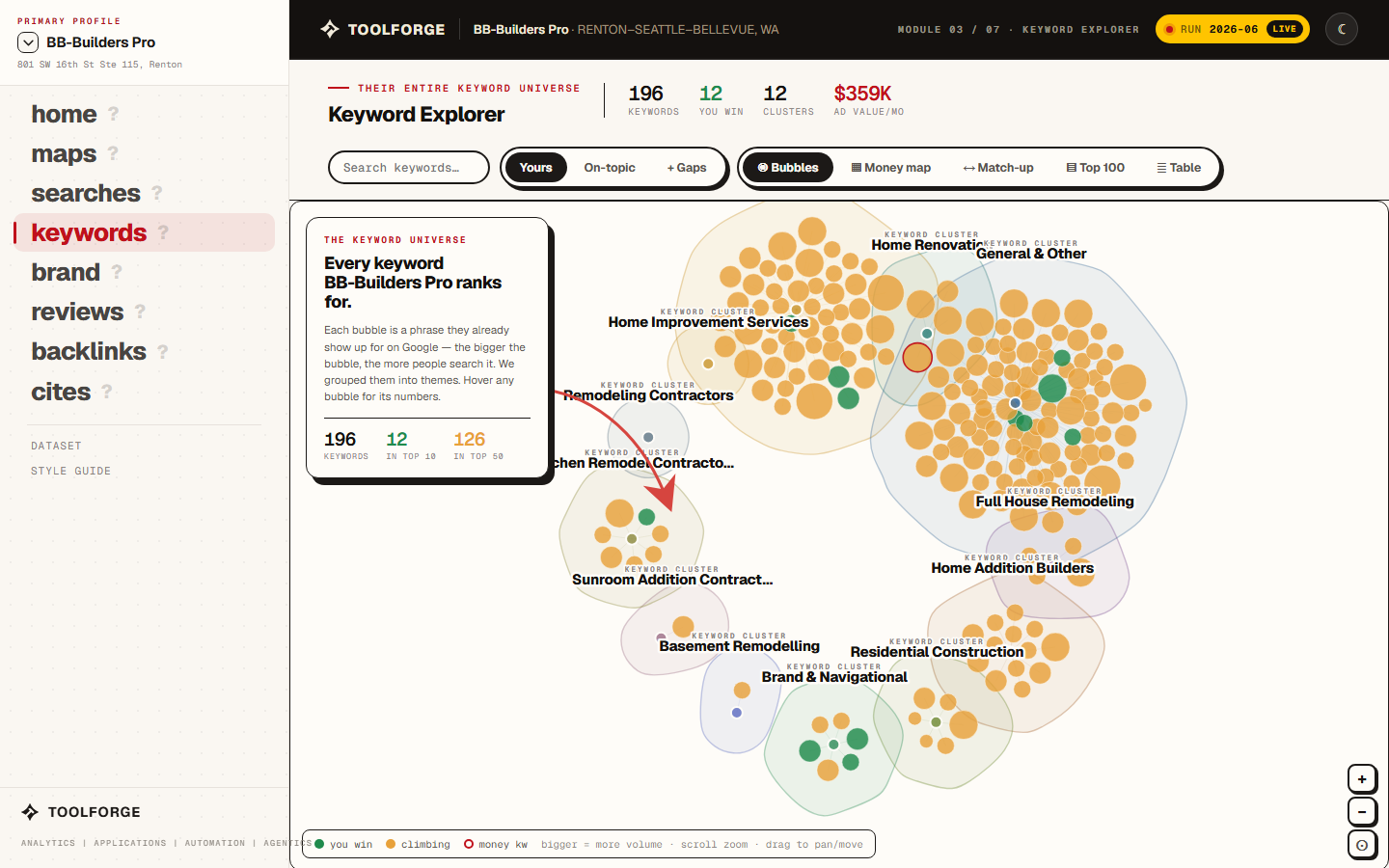
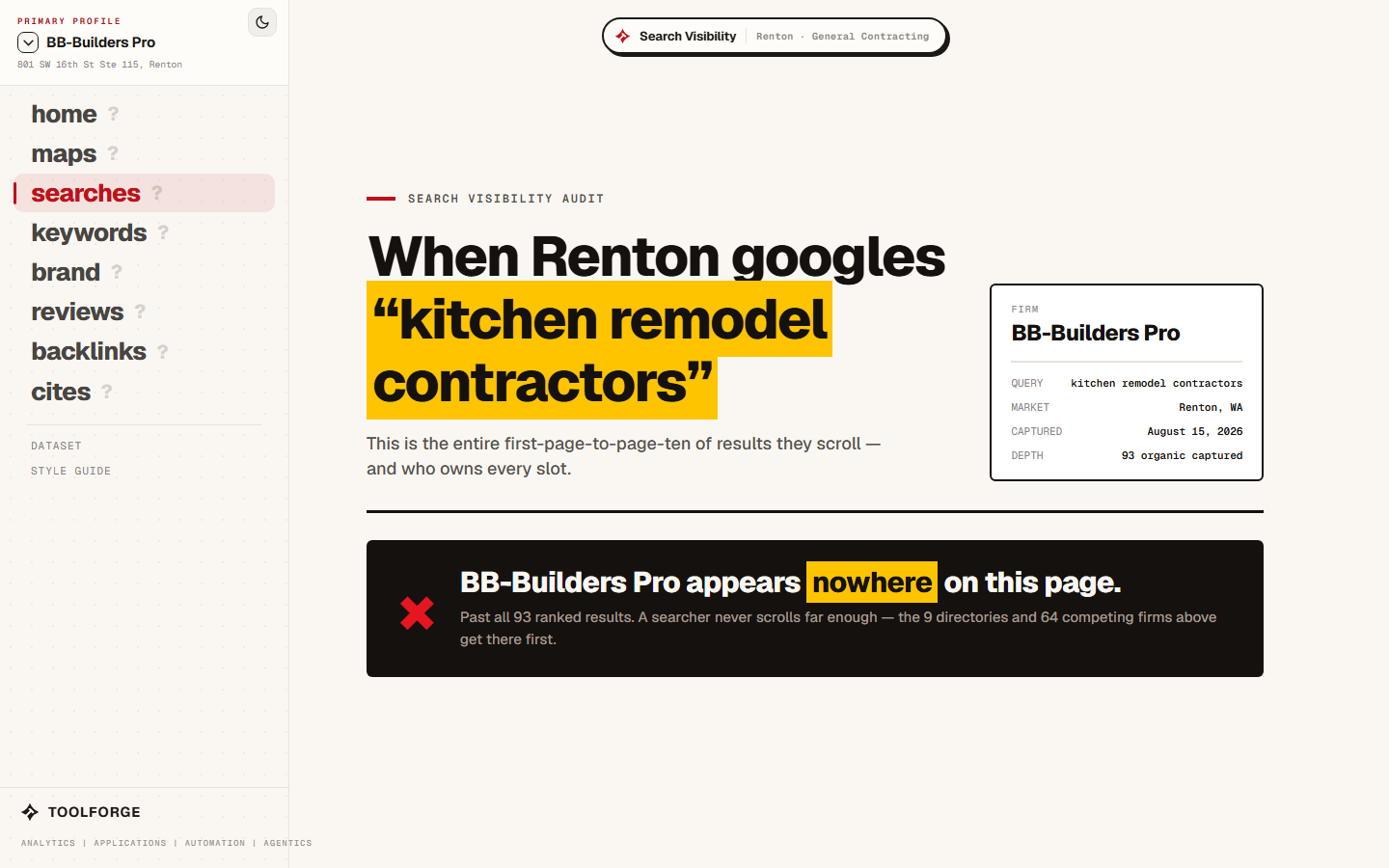
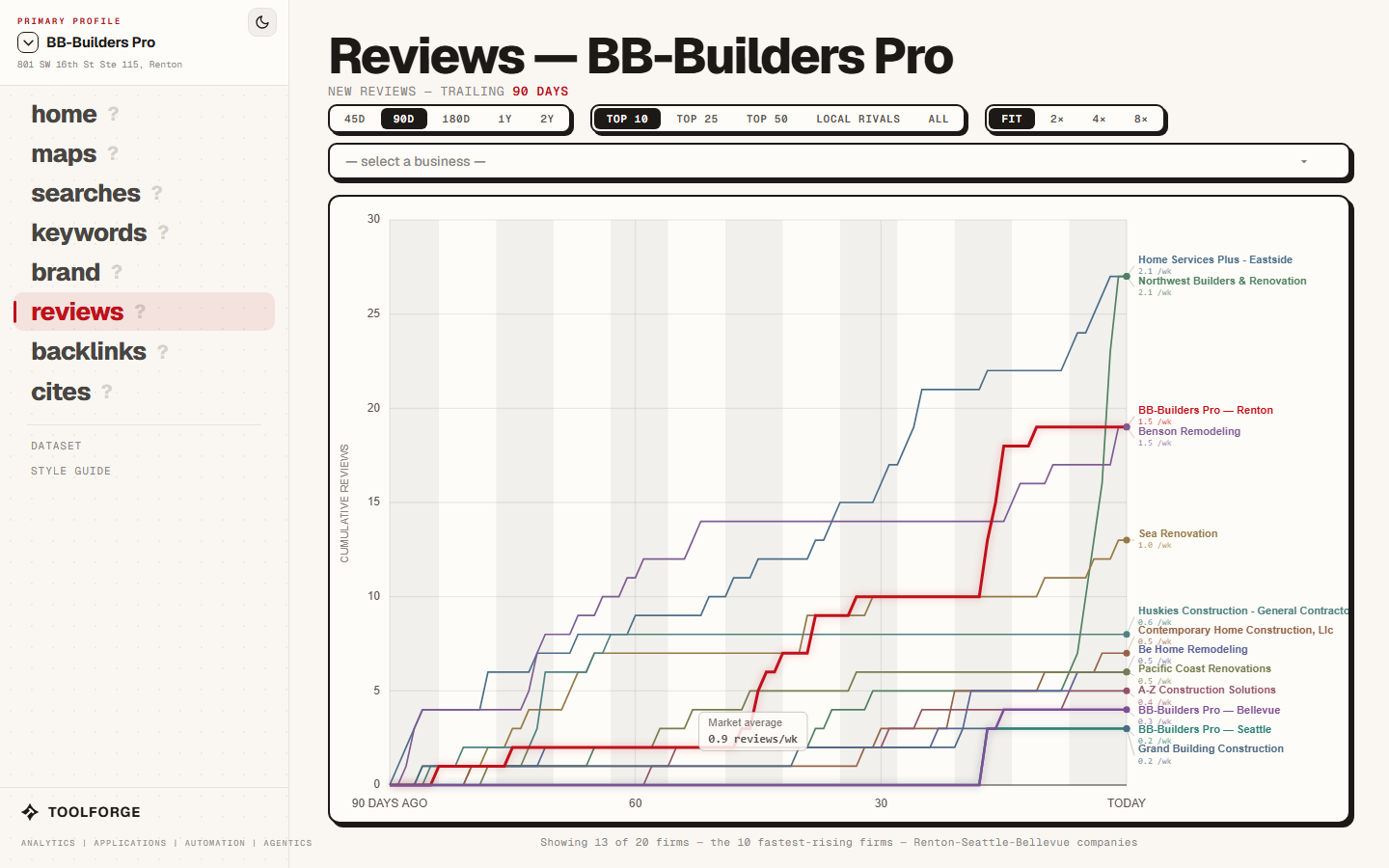
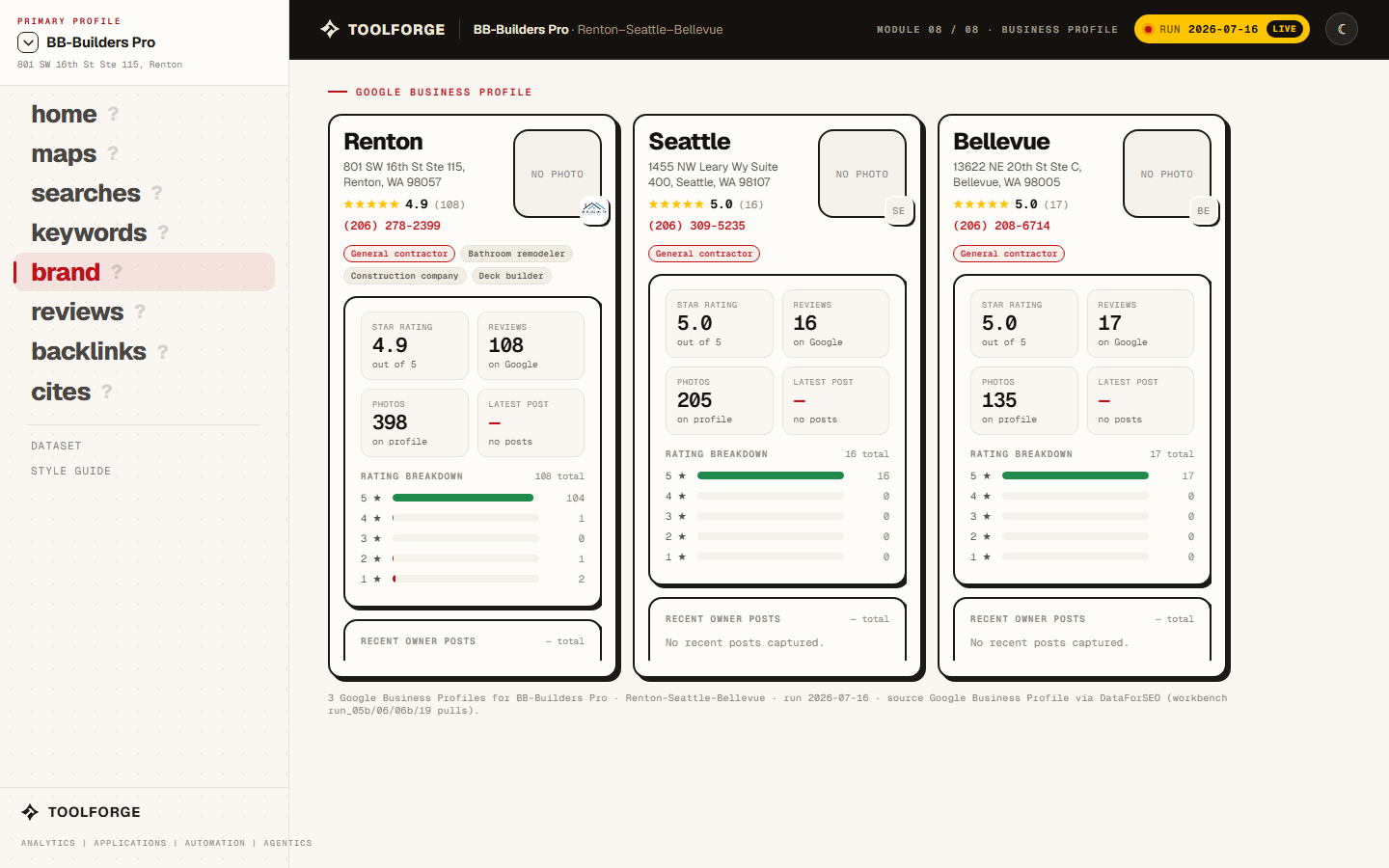
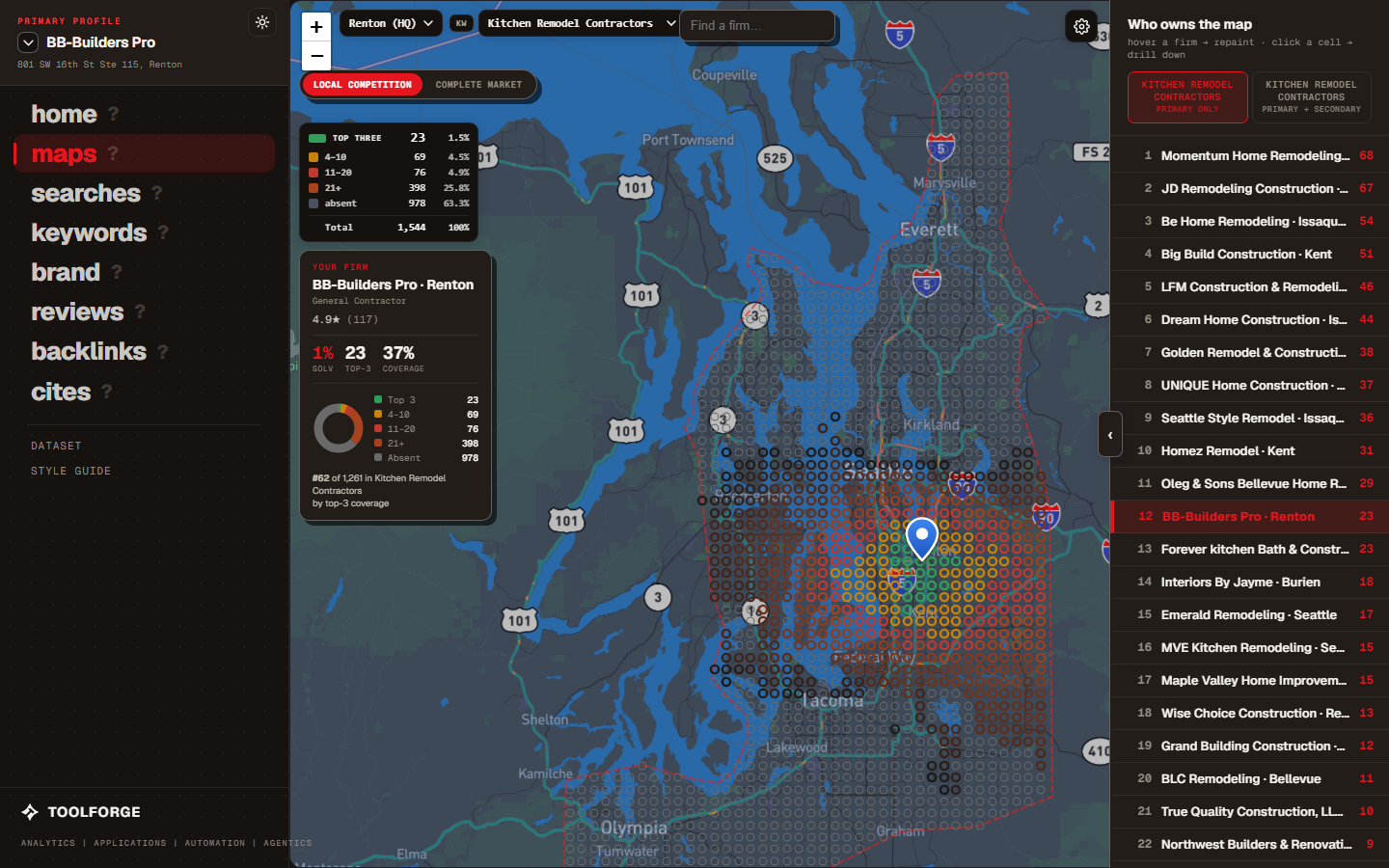
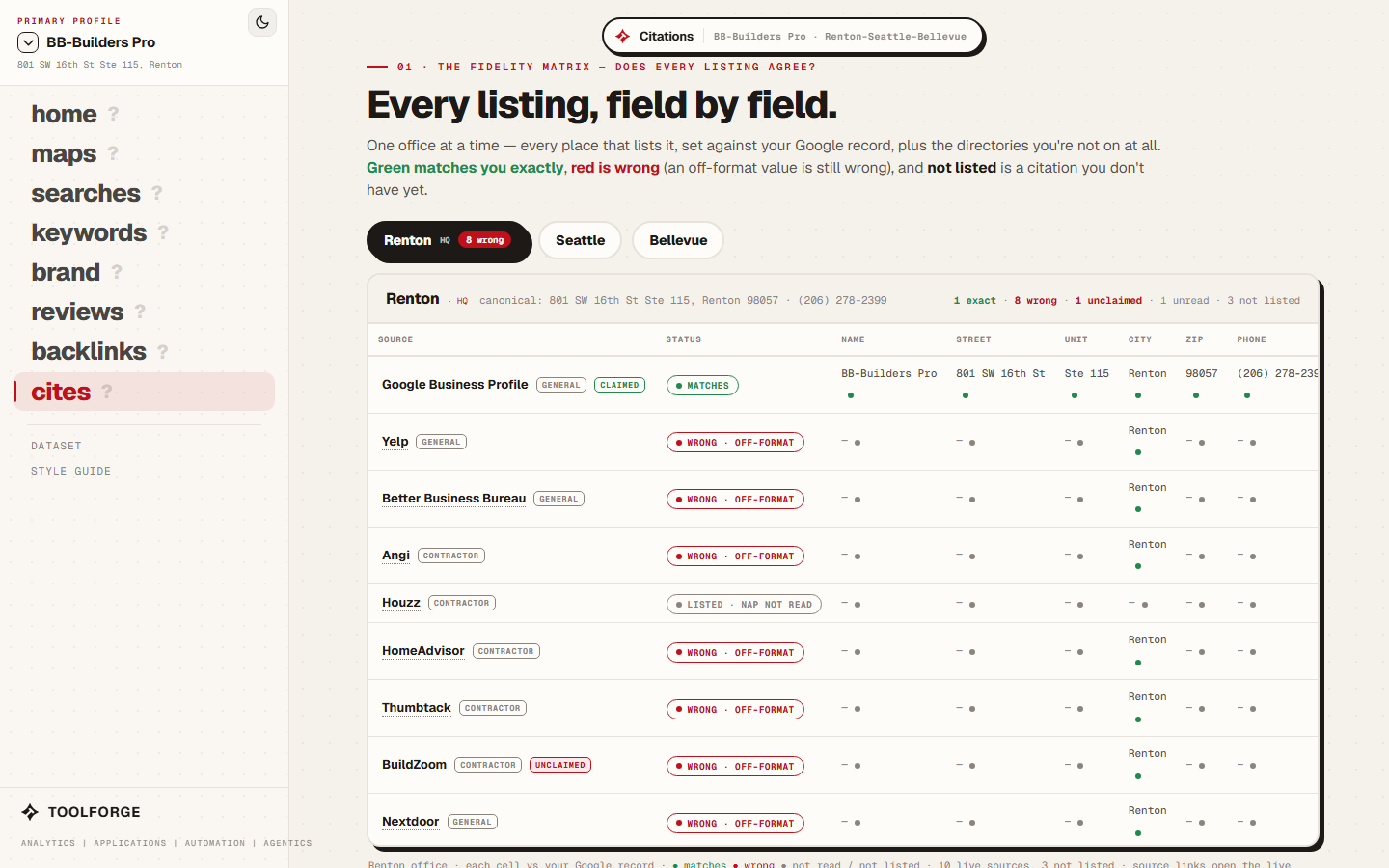
The posting asks for SEO experience. I did not answer that one in prose — I answered it by scanning your market. I have direct access to the same source data the big SEO platforms sell, and I checked Google’s map results across Puget Sound on the highest-value remodeling searches, recorded where each of your three listings appears, crawled the site, and audited the listings. The short version: your reviews and your content are winning, your website is not keeping up its end, and the gap between the two is the cheapest growth available to you right now. The full argument is the first letter and the diagnostic, linked below.
What I would build for you
Three things from the possibilities column. Each one is something I have already built for someone else — nothing here is speculative.
The ask
Same as when we talked, and take whichever shape serves you. Bring me in as a fractional data, content, and search lead beside the marketing manager you hire — they take brand, social, creative, and the team, and I take the technical and analytical side: the search engineering, the GoHighLevel and Buildertrend plumbing by API, the agents, and the reporting. Or, if it suits you better, I will cover the whole posting, minus whatever you would rather keep in-house.
Everything behind this letter
All of it is live, and all of it reads from the same measurements. Nothing below is a mock-up.
Let’s have lunch next week.
We can walk through any of this at whatever depth you like — the dashboards, the diagnosis, or the role itself. I’ll give you a call Monday morning. Either way, you keep everything on this page.